Council’s Strategic Framework
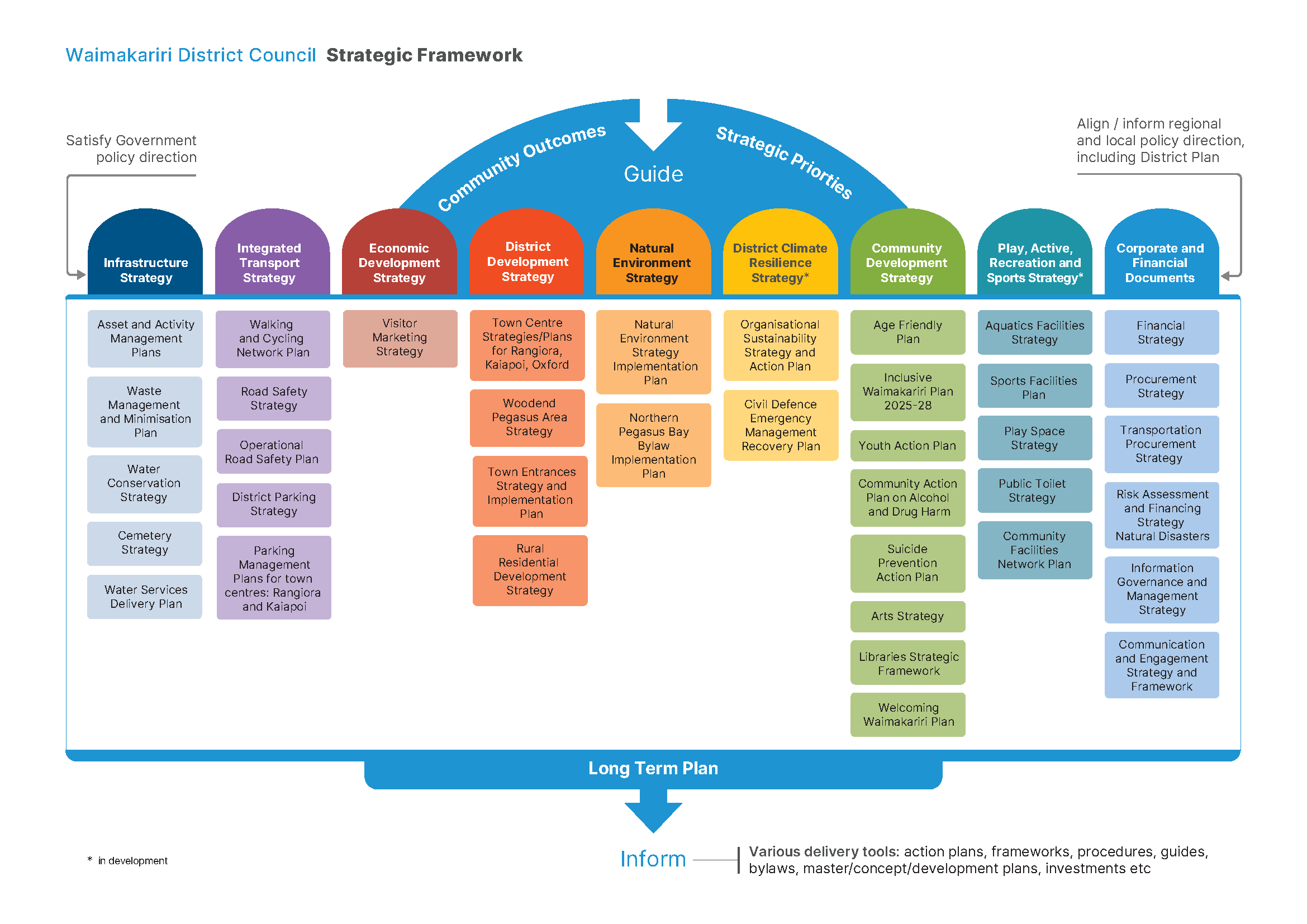
Council has developed, with input from our communities, strategies and plans which set out the vision, objectives, directions and actions to achieve outcomes for specific issues or areas, and to meet the current and future needs of our community.
Collectively, these strategic documents contribute towards achieving Waimakariri’s Community Outcomes, which are high-level, long-term goals identified by our communities to improve wellbeing for now and the future. Our strategies and plans also respond to Council’s Strategic Priorities, which are the key issues Council wants to address during its term. Both, the Community Outcomes and Strategic Priorities are articulated in the Council’s Long Term Plan. Directions identified in our strategies and plans are then delivered through a range of implementation tools.
Together, all of this makes up our Waimakariri Strategic Framework :
Strategies & Plans
Click below to find out more about each strategy within the Waimakariri Strategic Framework, as well as links to the several plans that collectively provide more detailed roadmaps and have a “line of sight” to the overarching strategy. They do not sit in isolation however but have many strategic crossovers with each other. National and (sub)regional policy directions also provide important context for each.
The Infrastructure Strategy 2024-2034, which is included in Council’s Long Term Plan, summarises the current state of Council’s infrastructure and importantly outlines the key strategic issues facing the Council and its proposed response.
- Community and Recreation Activity Management Plan 2024
- Sport and Recreation Reserves Management Plan 2015
- Neighbourhood Reserves Management Plan 2015
- Water Supply Activity Management Plan 2024
- Wastewater Activity Management Plan 2024
- Urban Drainage Activity Management Plan 2024
- Rural Drainage Activity Management Plan 2024
- Stockwater Race Activity Management Plan 2024
- Transport Activity Management Plan 2024
- Solid Waste Activity Management Plan 2021
- Waste Management and Minimisation Plan 2018
- Water Conservation Strategy 2010, revised 2020
- Cemetery Strategy 2020-2039
- Water Services Delivery Plan 2025
- Stormwater Management Plan 2025
The Integrated Transport Strategy 2035+ sets out how Council will manage our transport and mobility needs towards 2035 and beyond, to deliver on its vision: It is safe, easy and sustainable to journey to where we want to go.
The Economic Development Strategy 2024-2034 provides a framework that guides the Council’s and Enterprise North Canterbury’s efforts and activities in supporting local economic growth over the next ten years, with the support of key delivery partners in critical areas. Our vision is: A thriving, progressive and environmentally responsible economy that underpins a desirable local lifestyle.
The Our District, Our Future – Waimakariri 2048 District Development Strategy sets out growth directions for our main towns, gives the context for how we manage our rural and rural residential areas and our businesses, and provides the platform for how we meet the needs of our people through community facilities, infrastructure and connections.
The Waimakariri Natural Environment Strategy – Our Environment – Our Future is the Council’s local response to the degradation of important natural ecosystems and species being reported across the world, including our District. Informed by the Biodiversity State of the Environment Report, it provides a framework to guide Council’s work in protecting and restoring the natural environment over the next 30 years, and sets the vision: Our healthy and resilient natural environment sustains our ecosystems, our communities and our future. Also available to view is the summary of the Natural Environment Strategy - Our Environment - Our Future document.
Council will soon begin developing a District Climate Resilience Strategy to guide the transition to a low-carbon economy and prepare for the impacts of a disrupted climate, ensuring our communities, infrastructure, and environment remain resilient over time.
The Waimakariri Community Development Strategy 2025-2035 provides a framework for the next ten years and clear direction for the role that the Council plays in addressing identified community priorities. Its vision is: Communities that are safe, caring, inclusive and empower all to thrive.
Sport, active recreation, and play opportunities play an important part of Council’s purpose of making Waimakariri a great place to be. The Council is currently developing a Play, Active Recreation and Sports Strategy, which will, once adopted, inform facility development, community partnerships, place making and resource and financial investment.
The Council has developed a range of other corporate and financial documents critical to performing its role. These have been grouped together under this heading, rather than under an overarching strategy. Many are operational in nature, and enable important work to occur across many of our strategies, plans, implementation tools and other functions.